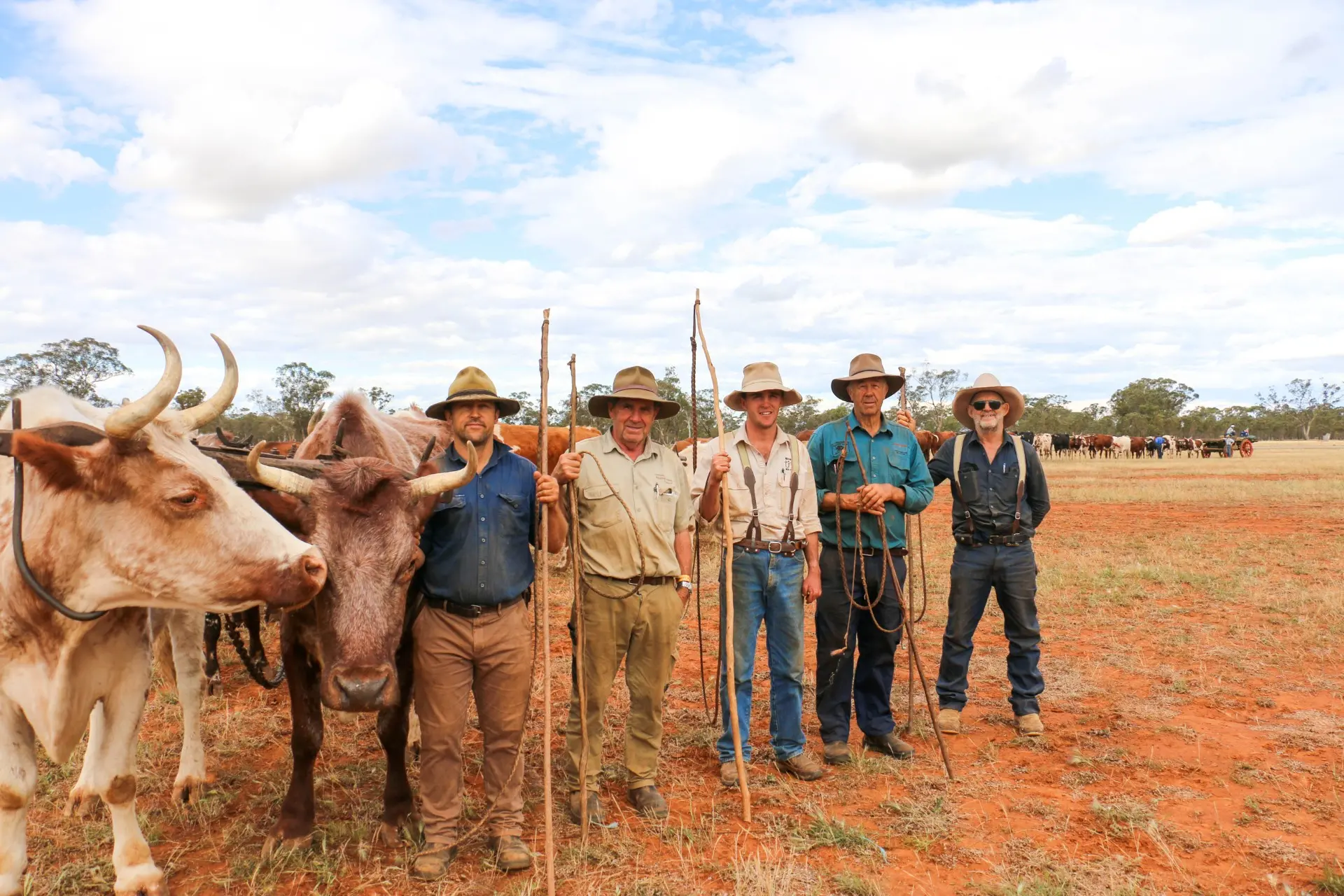
Five of the world’s greatest living bullock drivers combined their expertise to produce a stunning spectacle at The Good Old Days Festival of 56 bullocks, setting a new Australian record. Yoked in pairs, the huge team pulled an historic Australian-built wagon into the books to set a new 21st century record on October 3, eclipsing the previous one set in 2025 of 40 bullocks also at Barellan, NSW. The team comprised 14 bullocks from Rohan Morris, Maryvale, Qld, 10 bullocks from Matt Stanford, Chinchilla, Qld, 12 from Phil Thomson, Numinbah Valley, Qld, Darcy Quinn, Tumut, with eight, and 12 from Ron McKinnon, Tomerong, NSW. Offsider was Joey Reedy, Condobolin, NSW. All of the bullock drivers rated the experience as their career highlight. Mr Thomson said the composite team at The Good Old Days Festival, Barellan, contained every large active team in the nation and comprised both dairy, beef and crossbred bullocks. The breeds represented were Friesian, Ayrshire, Australian Illawarra Shorthorn, Droughtmaster, and Hereford. The leaders, Willy and Robin are 10-year-old Illawarra Shorthorns bought out of the Warwick saleyards when destined for slaughter. The wagon itself was unusual as it featured springs on slippers, a system used in the first models of trucks produced. Three of the bullock teams completed a 40km trek via the Flagg family property at Moombooldool to load with wool bales and return along the stock route to Barellan in the lead up to the Good Old Days Festival. Not content to establish a new Australian record, the bullockies also put together a unique in the world, four-abreast team, or two teams of pairs yoked together. Mr Thomson said the last remaining image of such a configuration was taken in 1925, making the sight not scene in Australia in a century. He said every configuration was designed to maximise the efficiency of pulling power available without over taxing the animals. “The idea was to bring the power closer to the wagon – most bullock teams logging in the bush were 14 to 16 and increased to 22 or sometimes 26 for the wool teams on the road,” he said. The huge team responded to voice commands from the bullockies and even put on a fantastic display for the crowd by creating a huge circle with the leaders almost catching the polers. Mr Thomson has travelled the world researching the origins of draft animal power and speaking on Australian bullock teams. “Australia’s teams have evolved to be efficient for our needs, and our industry is quite extensive compared to Europe where pairs of cows are used,” he said. “But the only reason bullocks have survived here is because of the timber industry and the gear is made for a one-man operation. The gear was so simple compared to what a draught horse required. “For a bullock team to be successful nowadays, you have to have a passion and a purpose.” Leading the team into the main arena was Queenslander Rohan Morris with his 14 bullocks, the largest number contributed to the composite team. Rohan, 47, uses his bullocks at home to haul logs for milling on his farm and is also a physical education teacher. He started at the age of 15 with a pair of Friesian steers from a neighbouring dairy farm. It was a proud moment for Rohan’s father Derek who said his son was inspired by a book written by Ron Edwards on bushcraft and belonging to his great grandfather. During school holidays, Rohan would receive mentoring from an experienced bullock driver. “I am pretty proud to see him out there with all the legends of the bullock teams,” Derek said.