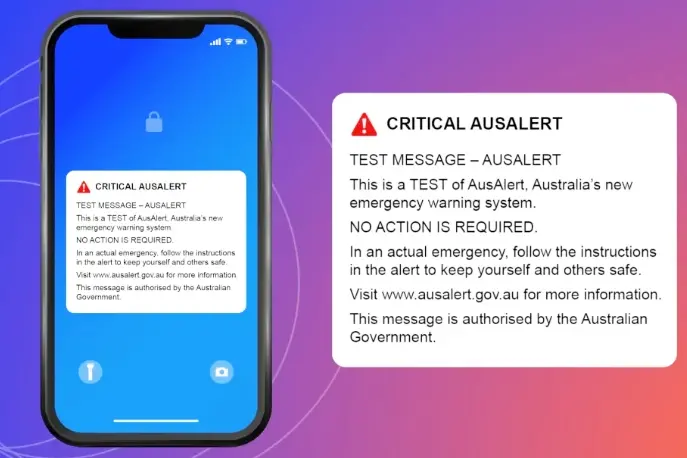
Most mobile phones will vibrate and play a siren-like warning sound at 2pm on Monday 27 July as a national test of AusAlert takes place to validate the system’s full capability and support awareness of the new system. During the national test, everyone with a compatible mobile device will receive an alert. AusAlert is a national program designed to help the government and emergency services warn people when they are in danger, thus saving lives and protecting property during a disaster. The program delivers on a key finding from the Royal Commission into National Natural Disaster Arrangements following the 2019/20 Black Summer bushfires. AusAlert will be ready to use in October this year, but before it launches, the system needs to be tested across Australia. On Monday 27 July, a test alert will be sent to all mobile devices in Australia at 2pm AEST. Everyone with a compatible phone or other device – some smart watches or tablets – in Australia can expect to receive the alert. Devices will vibrate and play a siren-like warning sound for about 10 seconds. An AusAlert message will appear on device screens. It will clearly say it is a test. Exactly how it appears will depend on your device type and operating system. If you receive a test alert, you don’t need to do anything. It is just a test. But in an actual disaster, an AusAlert will tell you the type of emergency, where it’s located, how serious it is and what to do. It will also tell you the name of the emergency organisation that has sent the AusAlert and where to find more information about the emergency. If you don’t receive the test alert on 27 July, you don't need to do anything. Your device might not be compatible or maybe it wasn’t connected to a mobile tower at the time of the test. To make sure you're AusAlert ready, always install the latest software updates on your device when asked and be sure to restart your device after updating. AusAlerts contain important information and should be turned on to help keep you safe. As the AusAlert national test is a critical alert, you can’t turn it off via your device settings. If you don’t want to receive the AusAlert national test message, the only way not to receive the critical alert is to turn your mobile device off or switch it to ‘aeroplane mode’ for the duration of the test. If receiving an AusAlert test message will disrupt you or cause you or a family member to feel unsafe, turn off your mobile devices or switch them to aeroplane mode before the scheduled test time in your location and leave them off for at least one hour. The federal government says AusAlert is a major development in Australia’s emergency communication landscape. AusAlert will use the latest technology to enable authorities, including states and territories, to send geographically targeted emergency messages to all compatible mobile devices within a 160-metre accuracy. The system will not be impacted by telecommunication network congestion, helping communities to understand the risks and make appropriate decisions about their personal safety. AusAlert will be supported by a dedicated website. This forms part of a wider public awareness campaign that will ensure all Australian people clearly understand how the system works and what to do if they receive an alert. Minister for Emergency Management Kristy McBain said the national test is a significant milestone for AusAlert. “The Albanese Government is undertaking these tests to ensure the technology performs as expected and to build community awareness before AusAlert is needed in an actual emergency,” Ms McBain said. “This is an important project that will help us and emergency services organisations warn people when they are in harm’s way, saving lives and protecting property during a disaster, delivering on a key finding from the Royal Commission into National Natural Disaster Arrangements. “This is a major development in Australia’s emergency communication landscape, and I thank Australians in advance for their cooperation as we move into the launch phase for AusAlert ahead of the next high risk weather season.” Community-based trials were undertaken in June, ahead of the national test this month on 27 July.